Field of Science

Showing posts with label virus. Show all posts

Vaccines and viral evolution

ResearchBlogging.orgThis is the first time in ten years that I haven't had an exam around summer-time. It feels odd, everyone around me is either exam-stressed or post-exam-relaxed, it's turning to summer and there's a definite final term feeling but this time I'm not really part of it. It's been an interesting year this year, since January I've not been involved in any part of research science, other than writing about it.

However luckily I'm still surrounded by lectures, seminars, talks and various other interesting stuff which no one seems to mind me occasionally turning up too. Seeing as I haven't written much about virus's lately I headed over to a talk the other day about Marek's disease, which is caused by a Herpes Virus and has a rather devastating affect on chickens.
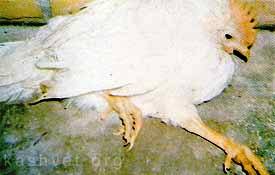
It makes them stand like this :(

It started back in the sixties, when rather a lot of chickens suddenly started dropping dead, sometimes up to 50% of all the stock in a large barn. Bear in mind these weren't the happy pecking-around-shrubs-of-grass chickens that feature on the front of free-range eggs, but rather a lot of chickens quite closely packed inside a big barn. The cause was found to be MDV - Marek's disease virus. After a lot of work a vaccination was found and given to all the chickens. Over $2 billion was saved by this, and the chickens were able to survive, right up until they got slaughtered for food.

But then, around the 1980s the disease suddenly reared it's head again, this time in a far more virulent form imaginatively labelled vvMDV (which stands for very virulent MDV). More research, another vaccine, and the deaths stopped.

Until just before 2000 when the virus evolved again into an even more virulent strain called vv+MDC, which means exactly what you think it does. Another vaccine was made (called Rispens) but at this point it was becoming fairly clear that this virus was behaving oddly. Three times it had changed, becoming more and more deadly each time:

Image from the presentation slides showing the development of new strains with an increase in virulence.

This is not normal behaviour. Virus's rely on their hosts, they can't replicate, survive or do anything without a host cell, which means they have a vested interest in keeping the host alive. If anything, viral strains should evolve to become less virulent; a virus that kills the host will be a virus without a host and is therefore less likely to survive and propagate than a virus with a host.

It turns out in this case that the evolution of increase virulence is down exclusively to the way the vaccine interacts with the virus. The virus works by being inhaled into the chickens lungs, getting into the cells of the immune system (B and T cells) and causing a latent infection of the lymphocytes (T cells). Virus cells can also work their way to the epithelial cell of the feather follicles and will shed from under the feathers, thus keeping the virus in circulation.

In an ideal situation a vaccine would produce what is known as "sterilising immunity", where use of the vaccine kills all viruses dead. This is how almost all human vaccines work. With the Marek's disease vaccine however, the virus was not killed completely, but could still replicate and shed from the feathers. This means that the virus was still within the system, able to change and evolve. The vaccine however, does make the virus less likely to spread, which means that a more virulent form that the vaccine does not protect against is able to outcompete the less virulent strain. Because the chickens are all in very close proximity, and because there are a lot of them, the more virulent strain can spread much faster throughout the population. With normal chickens, in small isolated populations this would not happen as a virus that virulent would run out of host and die out.

This creates a paradox - vaccines are needed to stop the chickens getting the virus, but at the same time use of the vaccine is creating an evolutionary environment in which a more virulent virus can grow. There are some responses to avoid this though. Firstly, to develop a virus that produces sterilising immunity, i.e that kills all thee virus dead. Secondly, to allow the chickens more room and freedom to stop the virulent strains spreading so quickly. And while this second solution sounds like every animal-rights campaigner's dream, remember that it only really works if very few people in the world eat chicken. In reality there are lots of people, and a limited space for chickens - eating chickens which have lead a happy healthy life is a privilege for a few, not the reality for the majority.

---
Witter RL (2001). Protective efficacy of Marek's disease vaccines. Current topics in microbiology and immunology, 255, 57-90 PMID: 11217428

Witter RL (1997). Increased virulence of Marek's disease virus field isolates. Avian diseases, 41 (1), 149-63 PMID: 9087332
---

Follow me on Twitter!

Hitchhiking through the nervous system

ResearchBlogging.orgI while ago I wrote a post about how virus's get from the outside of the cell to the interior of the nucleus and found that virus particles are able to hitchhike on the cells internal transport systems. I was quite interested therefore to find a paper in Nature Reviews (reference below) that revealed that not only do virus's latch on to host proteins to travel around inside the cell, they also use host extracellular processes for travelling around the body. And outside the cell it's not just virus's either, bacterial toxins need transport systems too, unlike whole bacteria they can't move around under their own power.

One place that the body wants to protect particularly well against infection is the central nervous system. It provides this protection by surrounding it with a wall of tightly sealed endothelial cells known as the blood-brain barrier. However despite this the body itself still need to get some things into the CNS; small molecules such as glucose and oxygen as well as larger cells of the immune system. These immune system cells provide the first sneaky point of entry; virus's such as HIV can hitch a ride inside these cells and get into the central nervous system that way. This is the equivalent of hiding in a truck to avoid border patrols.

However some virus's and toxins use an even more sneaky method, dressing up as a border-patrol guard and simply walking in. Throughout the blood brain barrier there are long neuronal projections that connect the central nervous system to peripheral organs. A picture of one of these cells is shown below:

Like all cells, this contains the transport molecules Kinesin and Dynein, which virus's can latch onto in order to transport themselves through the cell (see earlier post here). Once they get inside the cell, the cell's own proteins will carry the virus particles all the way through it, and into the central nervous system. However first it has to get inside the cell, through the little blue blob at the bottom (in the diagram above it's highlighted with a little dotted square).

As well as receiving chemical signals for electrical impulses (that make the neuron function as a nerve) the blue blob also contains various different receptors capable of engulfing and uptaking small molecules, including those used to signal some neural impulses. This means that there are a range of chemical receptors on that blue blob which allow the uptake of molecules, and you can probably tell where this is headed...
The diagram above is the intramolecular equivalent of Han Solo dressed as a Stormtrooper wandering into the Death Star. By changing its outer coat enough to mimic the proteins that are usually taken up by the cell the Herpesvirus can attach to the outer membrane and then be absorbed into the cell. Once inside, it can latch onto the dynein and get a free pass all the way into the nucleus (and neurons are pretty long so it is a bit of a journey). Poliovirus and rabies can also carry out this trick (at the neuromuscular junction for anyone interested) along with the bacterial botulinum toxin, which gets taken up by synaptic vesicles and essentially kills the end of the nerve, which can either lead to instant death or a scarily smooth robot-plastic forehead, depending what context you take it.

I always find it quite spooky to think of my body in that way, as a huge maze of intracellular processes, being negotiated, infected and protected by tiny substances outside of my conscious control. I think that's another reason I find cellular biology so fascinating, by studying it we gain control (or if not control at least an understanding) of these detailed processes that we would not normally be able to influence.

---

Salinas S, Schiavo G, & Kremer EJ (2010). A hitchhiker's guide to the nervous system: the complex journey of viruses and toxins. Nature reviews. Microbiology, 8 (9), 645-55 PMID: 20706281

Norovirus and Clinical Research


ResearchBlogging.org
I've written a lot about bacteria and plants over the last few weeks, so in celebration of the fact that my project is finally on it's way out (with a whimper rather than a bang, unfortunately, but that's how it goes sometimes) I've decided to descend into the world of viruses. I've also decided to have a go at deconstructing some clinical papers, to make a change from academia. The difference between clinical and academic research can probably be described as follows (and I'm pretty sure I've stolen this quote from somewhere else, but can't remember where):

Clinical Researcher: "That's interesting, but it is useful?"
Academic Researcher: "That's useful, but is it interesting?"
[Industrial worker: "That's useful and interesting....can we sell it?"]

Clinical papers therefore have a different slant from academic ones. They tend to be a lot more precise, a lot clearer. Most will include data from actual people rather than just biochemical data, and the real-world applications come across as the main focus of the study, rather than just tacked onto the end for funding purposes. It comes across in presentations as well, I went to the Society for General Microbiology conference last year and you could usually tell within about ten minutes whether you were listening to an academic, industrial or clinical researcher.

But anyway...on to the papers, which deal with Norovirus, a viral infection usually thought of as a mild (if unpleasant) winter vomiting disease. Norovirus is an RNA virus, which means that it consists of a coil of RNA wrapped up inside a spherical protein coat, as shown to the right
(image taken from the Naked Scientists):

The virus enters the body through the mouth, and invades the small intestine, resulting in lesions in the small intestine tissue and an increase in mucus production. This affects the absorption of nutrients, and leads to build-up of food in the stomach (which can't move down into the intestine) which in turn leads to vomiting and diarrhoea and generally feeling unwell.

Norovirus usually peaks during the winter months, probably because during the winter people tend to spend a lot of time stuck in the enclosed areas with other people. However in 2002, this decline during the summer months halted, and incidents of the disease began to increase, particularly in the over-65 age range. This is due to the emergence of a new variant of the virus which has a higher human-to-human transmission and is therefore more likely to spread in areas where people are living in very close proximity, such as nursing homes and hospitals.

As these places tend to be full of people who are not at their most healthy, this can lead to serious complications in the disease. The damage to the intestines can lead to dehydration which in some cases has been severe enough to lead to kidney failure. Diarrhoea and vomiting cause potassium loss, which can lead to problems in the heart. Deaths are thankfully uncommon, but have been reported.

What this means is that norovirus shouldn't really just be thought of a mild disease any more particularly (which one of the main issues with for clinical researchers) when it happens in hospitals. There's no vaccine against it, as multiple strains exists and having norovirus doesn't really give you much of a defence against getting it again. There has been some work done with the capsid proteins (which surround with RNA of the virus) but as yet this is still happening in mice, and I'm not sure whether it's even entered clinical trials. The best current defence against norovirus is still just to keep things as clean as possible, especially in places where many people are in close proximity, to keep very ill patients away from as many other patients as possible, and to tell doctors to stay at home if they wake up vomiting.

One of the great things about Medical science of course, is that it's an ongoing process and we are the data-sets. This summer rolling around (soon, hopefully!) will bring more information about the state of norovirus, whether the trend in increasing virulence is still around, or whether it's starting to die down. Either way it's a good reminder that sometimes all it takes is a particularly busy hospital and a blip in a piece of floating DNA to turn a relatively harmless disease into a much more problematic one.

---
Hane Htut Maung (2008). Norovirus Infection: An Underestimated Danger Cambridge Medicine, 22, 22-24

Lopman BA, Reacher M, Gallimore C, Adak GK, Gray JJ, & Brown DW (2003). A summertime peak of "winter vomiting disease": surveillance of noroviruses in England and Wales, 1995 to 2002. BMC public health, 3 PMID: 12659651

---
Follow me on Twitter!