Field of Science

Signals for Infection

ResearchBlogging.orgNeisseria meningitidis is a bacteria which lives in the throats of around 30% of the human population. In most cases it causes no problems at all and just exists as a normal part of the throat microbial flora. In some patients however it can start to colonise the bloodstream and brain, leading to cases of septicemia and meningitis which are highly dangerous and can be fatal.

The invasion starts with individual bacteria, which adhere to the epithelial cells that cover the inside of the throat. They then start to divide and proliferate to form large aggregated colonies. Within these colonies they are connected to each other, and to the epithelial cells, by protrusions from the bacterial cell surface called pili which are shown below for a wild-type (i.e un-genetically modified) Neisseria meningitidis:
Image taken from the reference below. The arrow points to one of the pili, and the insert shows a close-up of it.

These pili are often modified by the attachment of small molecules to the pili proteins, including the molecule phosphoglycerol (shown on the right for those interested in structure). To test the effects of the addition of phosphoglycerol, the researchers found which gene caused the addition of this molecule onto the pili (the pptB gene), and removed it from the cell. Without the pptB gene there was still the same number of pili around the cell, but they were not clumping together as much. Instead of the thick fibres seen in the wild type above (caused by large bundles of pili) only little stringy fibres were seen. These thin spindly fibres show that without the addition of phosphoglycerol, the pili cannot clump together.

This is important medically as Type IV pili bundle formation and N. meningitidis aggregation for infection are linked. Interestingly it was not the aggregation that was affected by removing the phosphoglyerol but the ability of individual bacteria to leave the aggregate to infect other parts of the body. In wild-type bacteria, the pptB gene is strongly activated only after several rounds of division within the aggregate, so it looks like the addition of phosphoglycerol acts as a switch, communicating to the bacteria that enough of them have aggregated and it is now time to leave. If the pptB is activated due to large numbers of bacteria it could act as a communication of the population density - signalling to the individual bacteria that the current location is far too crowded, and it has better chances of survival if it leaves.

---
Chamot-Rooke J, Mikaty G, Malosse C, Soyer M, Dumont A, Gault J, Imhaus AF, Martin P, Trellet M, Clary G, Chafey P, Camoin L, Nilges M, Nassif X, & Duménil G (2011). Posttranslational modification of pili upon cell contact triggers N. meningitidis dissemination. Science (New York, N.Y.), 331 (6018), 778-82 PMID: 21311024
---
Follow me on Twitter!

Multicellular signalling

ResearchBlogging.orgI like studying bacteria. I find them fascinating, wonderful little creatures, able to do as much (and often more!) with a single cell as other organisms need whole multicellular bodies to achieve. I like exploring the places bacteria live, the things they can do, the ways they manage to exploit practically every niche on earth, and of course most importantly how I can exploit them.

But not everyone loves bacteria, and at heart I am a biochemist which means, among other things, that I get to teach younger biochemists. This means I do occasionally find myself venturing uncertainly into the world of the multicellular and while doing so recently I found an interesting paper on cell signalling (reference below) which I thought I would share.

All cells need to be able to communicate, but while bacteria know that everyone they communicate with is a competitor, multicellular organisms have cells that need to be able to cooperate in a strange and slightly twisted form of cellular-communism. Each cell needs to know when it can divide (usualy never), when to grow, when to release chemicals and, ultimatly,when to sacrifice itself for the Greater Good.

Cellular communication is mostly a chemical affair, with small molecules called ligands being sent from one cell to another and recognised by receptors on the cell surface. These receptors can take many forms, but one of the more common ones is the form of a seven-transmembrane spanning receptor, so called because it goes through the membrane seven times:

Picture (c)me and my dodgy art skills. The protein is in blue, the membrane in pink, and the ligand bound on the outer cell surface is the red blob.

Binding of a ligand causes a conformational change in the whole structure, most importantly in that long intracellular tail shown above. This can then activate other molecules inside the cell, with the end result that a specific gene is turned on or off. In the classical model of this process the intracellular tail interacted with a little molecule called the G protein which carried the message through to the genome. Another protein that featured in this model was B-arrestin, which was thought to desensitise the receptor and the G-protein by re-setting it back to its original state, i.e switching the thing off. This model is shown below:

Picture (c) me. This is a simplified diagram, in 'reality' there are a lot more different proteins involved, but these are the main ones, and the important ones for this paper.

New evidence is coming to light which modifies this model. Firstly, it's been found that the B-arrestin does more than just switch off the G-protein, it is also capible of sending its own signals, through a cascade of different proteins. Both the G protein and the B-arrestin can be used to pass on the message sent by the ligand. Secondly, it's been found that these two proteins are not activated equally, a bias can be displayed, sending the signal through one of these two intermediate proteins; either the G protein, or the B-agonist or a mixture of the two. This bias can be either due to the properties of the receptor, or those of the ligand binding to it. Experimentally you can generate a bias by altering either the receptor or the ligand to prefer binding to the B-agonist, and you can plot these on mathematical-looking graphs.

You can tell this is a biology graph because there are no actual numbers, just vague concepts :p (c) me.

The actual physiological effects of this are only starting to be explored, as it introduces an extra level of complexity to intracellular control. The use of several different ligands, all with varying degrees of bias at the same receptor, could produce more subtle cellular output responses. Within a multicellular organism, the better your intracellular communication is, the more likely your organism is to grow happily and survive.

---
Rajagopal S, Rajagopal K, & Lefkowitz RJ (2010). Teaching old receptors new tricks: biasing seven-transmembrane receptors. Nature reviews. Drug discovery, 9 (5), 373-86 PMID: 20431569
---
Follow me on Twitter!

Designers know how to party...

Last Tuesday was the Brit Design Award of the Year Nominees party. It took place in the Design Museum in London, which was full of wonderful displays showing off cars, computer games, small models of architectural wonders and some random coloured bacteria...

The E. chromi display table for the Brit Design of the Year Award

The display table showing off the E. chromi project (i.e coloured bacteria) was almost exclusively organised by Daisy and James, our two awesome designers. One side covered the work we did during iGEM, with resin moulds made to look like bacterial streaks for each colour, next to very diluted DNA preps for each sample (homeopathic DNA by the time I'd diluted it enough to be acceptable for display purposes :p ).

The DNA sequence is written above the test-tube. It was hard to take this picture without a reflection of the camera showing. Also there were people behind me who wanted to actually see the display and I didn't want to block them for too long.

The other side of the table was the colour-futures side, which featured various potential applications of our work. Pride of place was for the Scatalog, the wonderful idea of using coloured bacteria to sense any internal infections or illnesses by swallowing bacteria in a Yakult-style yoghurt drink and producing a clear colour signal in, well, in poo. We also had a prototype kanamycin bomb, used by future protesters against colour patenting to wipe out the bacteria responsible for specific colour production.

Orange Liberation Front - free the rainbow!

The most amazing thing about this, more amazing than being nominated for anything, was that people were seeing our work. That's something that I'm learning doesn't happen all that much in science. Unless it's published, work barely gets out the lab, and even then unless you're very lucky it seems to stay within the field you're working in. To suddenly see a large number of random people looking at our work was a fascinating experience. Not all of them totally understood it, and the fake-poo in the scatalog certainly got some very odd looks but it was getting out there. In public.

I love designers. They make my science awesome :D

Coloured bacteria vs. Angry birds

For those who didn't catch the news when it first came out, the iGEM project I carried out in the summer of '09 has been nominated for a Design Award! The Brit Insurance Design of the Year 2011 to be precise.

I'm very excited about it, even though I don't really feel like a designer (I don't own a singlething made by Apple). We're up against some pretty intense competition, such as the Angry Birds phone game, Rock band 3 and quite a few phone apps. Still, it's pretty awesome to be nominated, and I'm looking forward to seeing all the rest of the project displays.

Our two wonderful designer-friends James King and Daisy Ginsberg have put together a great video explaining the project. It's got some great animation, and clips from a radio interview with one of my fellow lab rats, and even some pictures of the infamous Orange Liberation Front...

E. chromi from Alexandra Daisy Ginsberg on Vimeo.

Conference Blogging!

A new blog has turned up at the Nature Scitable blog-network: ConferenceCast. This blog is managed by no other than your now-not-very-anonymous LabRat and will feature reports (mostly by students) from conferences all over the globe, covering as many different aspects of science that I can find. If you ever wanted to know what goes on inside the mysterious world of science conferences, or if you've been to many yourself and want to catch up on the new ones, that's the blog to follow.

It's not the only new thing at Nature Scitable. There's also Our Science, that explores the mysteries of everyday life, Green Science, which covers biodiversity and ethical issues, MedSci discoveries, and several others. The landing page for all of them is here, and many are written by high-school or undergraduate students so will be well worth checking out.

As I said, I'm in charge of running the ConferenceCast blog, so I am currently looking for conferences to cover! If you, or any of your colleges, are attending any conferences in the coming months and feel like having a go at blogging it, please don't hesitate to get in touch, especially if you're a student! I know conferences can often seem overwhelmingly busy at the best of times but it won't take too much longer to email me a couple of paragraphs on what went on. You can find my contact email on the ConferenceCast page (and there's a nice picture for the stalkers).

I'm going to enjoy managing this new blog, and I hope some of you will enjoy reading it!

Targeting dormant bacteria

ResearchBlogging.orgAntibiotics are effective against bacteria because they target and knock out specific functions that are vital for bacterial survival. As most bacterial infections involve rapid growth and division of the invading bacteria, many commercial antibiotics currently target metabolically active cells, by blocking enzymes needed for growth, reproduction, or cell wall synthesis. While these will kill acute bacterial infections they are often far less effective against dormant bacteria in longer-term persistent infections.

Rather than targeting metabolic enzymes, the current strategies being explored to combat dormant bacteria target either the membrane, or membrane bound proteins. Both of these approaches destabilise the bacterial membrane and help to break the cell apart and can act against processes such as energy synthesis which occur in both active and dormant cells.

a=targeting important metabolic proteins in the membrane. b=targeting the actual cell-membrane. Picture is copywrite me :p

In eukaryotic cells, such as the cells of plants and animals, the enzymes that create energy for the cell are kept safely hidden away in specialised intracellular compartments, such as mitochondria. As energy production requires an ion gradient across a membrane, these compartments all have sets of internal membranes. Bacteria however do not have this luxury, and instead have all their metabolic enzymes in the outer cell membrane, as this is the only membrane they have. Inhibitors of energy metabolism can therefore bind directly to target enzymes in the membrane involved in the production of energy. This can be highly effective against cells whose interior is hard to get into, such as Mycobacterium tuberculosis which lurks inside tuberculosis granulomas. Even in the absence of growth, cells still require a minimal energy input to survive, so blocking off these enzymes kills both dormant and active cells.

Drug developed to help combat TB by attacking cell membrane metabolic enzymes. This drug is currently in stage three clinical trials.

The membrane-targeting drugs act directly on the lipid bilayer that surrounds the bacterial cell, breaking it up and destroying the bacterial cellular integrity. Although human cells are also surrounded by lipid bilayers they have fewer negatively charged phosopholipids and also contain cholesterol (not present in bacterial membranes) allowing membrane-targeted drugs to be specific for human pathogens rather than killing surrounding human cells. The drugs that are used to attack the cell wall can vary hugely in size and structure but they all share one common property; they are highly lipophilic (i.e they are attracted to lipids). This allows them to interact with the cell membrane and break it apart.
Lipophilic drug capible of targeting bacterial cell membranes

There’s something about those molecular diagrams of drugs that I love. I think it’s my biochemical background. I’m never totally happy with a schematic until I can see how the chemicals are interacting on a molecular scale.

As well as being useful against dormant bacteria these new antimicrobials show promise as strategies for dealing with arising antibiotic resistance. Bacteria can evolve to cope with as many challenges as are thrown at them, but hopefully it should take them a little longer learn to survive entirely without a cell wall…

Although there are some that can do that already.

---
Hurdle JG, O'Neill AJ, Chopra I, & Lee RE (2011). Targeting bacterial membrane function: an underexploited mechanism for treating persistent infections. Nature reviews. Microbiology, 9 (1), 62-75 PMID: 21164535

---
Follow me on Twitter!

Help needed - looking for a blog banner

There's been a slight lul in the actual science here as I'm preparing for a couple of very exciting bloggy things right now which include the need for a blog banner.

Does anyone know where I can get something simple and stylish to put at the top of my blog? I'm happy to pay a small amount but I am an impoverished ex-student so don't have that much money to spare. On the other hand I know a couple of other people looking for this as well at the moment, so I'd pass the name on.

Any hints please say in the comments or drop me an email.

Thanks!

New Year

Last year I made six New Years resolutions. Strictly speaking, I didn't actually keep any of them, but I made the effort and that counted for something. At any one time I could usually remember about four of them.

This year, I'm going to do something different. I've stolen this idea from someone else, and I'm not sure who, but the idea is that you chose just one word, and try to incorporate it into as many aspects of your life as possible.

My word is: Organisation

There are several reasons for this. The most important one is that the paycheques for my science-project have just stopped coming. However I do want to actually finish the damn thing, so I've taken up a part time job in a library to get me some money to survive while I'm doing that. I'll also be doing tuitions, supervisions and some exciting new bloggy stuff (can't say what it is right now but Watch This Space) just to scrape together a bit more cash. This means my day will have to be juggled between three hours of actual paid work, doing Science, organising lesson plans, marking essays, planning (and writing) blog posts and doing housework. None of those things can really be left un-done for more than a day.

I also need to be more organised with money as a) I'll have less of it and b) it'll be coming from all sorts of random sources and I need to keep track of it in case I get sent a letter about paying tax. As I'm no longer a student I can't use my overdraft any more because very soon I'll start getting charged for it. I need to make sure I'm keeping an eye on my PhD applications as well, before any deadlines accidently fly by me.

I'm getting married as well. They say it's good to be organised for that.

In the spirit of this I've already got two diaries (one for Life one for Blog) and a load of folders. I plan to spend New Years Day punching holes in bits of paper and sorting them all out into coloured files. Hopefully I'll get all the major bits of organisation mostly sorted in the first few months while I'm still all keen about it.

For everyone on the Gregorian Calender: Happy New Year!

Levels of evolution

This post was chosen as an Editor's Selection for ResearchBlogging.orgEukaryotes - animals, plants, and other creatures with a nucleus, evolve relatively slowely. Genetic variation occurs through changes in the DNA between generations; each offspring will be a genetic product of their parents and nothing else. Genetic changes happen down the generations. In bacteria, however, everything is a little more insane. Because bacteria can change DNA with almost any other bacteria they come accross, there is less of a conserved genetic record. Genes are flying around all over the place which can make it very difficult to seperate bacteria into neat taxonomic groups.

It's helped by the fact that bacterial genomes aren't completely random, and can usually be seperated into 'core' genes and 'accessory' genes. Core genes are most useful to taxonomists as they show what the bacterial species actually is, and where it sits within molecular phylogeny. The accessory genes are more interesting to bacteriologists as the play a more significant role in phenotypic differences and determin what the bacteria do. Paradoxically, the accessory genes are also the ones used most in adaption (think of antibiotic resistance) and are therefore more likely to be evolutionarily selected for or against. These accessory genes are often found in specific 'hypervariable' regions of the genome called genomic islands.

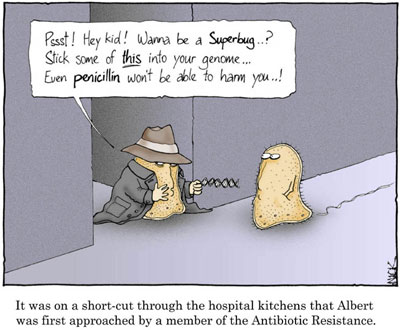
Cartoon by Nick Kim, www.nearingzero.net

The increase in second-generation sequencing technologies opened up the ability for large scale comparitive-genomics studies; essentially sequencing huge numbers of bacterial genomes and then comparing them all to each other. Back in the day, population studies were done using an approach known as MultiLocus Sequence Typing (MLST) - which took seven core genes and sequenced those for each bacteria. Nowadays you can sequences all the parts of the genome you need in hundreds of different strains.

As with most new microbiology technologies, these new techniques are initially being applied to human pathogens, as human pathogen research is (rightly) where most of the money is. Using wholescale sequencing technologies on pathogens such as Clostridium difficile which has high levels of antibiotic resistance. The grand aim is to try and understand both the extent and the distribution of natural genomic variation between one bacterial species. This could help to understand what roles are played by bacterial migrations, recombinations (switching DNA around), active selection and drift in the spread of antibiotic resistance.

C. difficile is a very genetically diverse species which has been evolving for the last 1.8 million years. As each bacteria is likely to replicate at least once a day, this allows for a huge amount of change and genetic variation. It might be suspected that the virulent species is formed from a single offshoot, one bacteria that became virulent and then passed that ability onto its offspring but instead it looks like virulence arose in many different lineages, most likely through horizontal gene transfer. This means that each different virulent strain is likely to show a relatively large amount of variation in the rest of its genome.

It isn't just small bits of DNA on separate plasmids that C. difficile can exchange, they can also carry out homologous recombination, a process by which whole sections of the bacterial genome can be cut out and shared between related species. This process is aided by the presence of 'mobile elements' within the genome, i.e pieces of DNA which are particularly good at jumping around and splicing themselves in and out of bacterial chromosomes. It turns out that the C. difficile genome contains lots of mobile elements.

From a bacteriologists point of view this is a fascinating example of just how variable a single strain of bacterial species can be. From a medical viewpoint it's more worrying. The ability of highly virulent bacteria to chop out large portions of their genome and pass them onto other, potentially non-virulent strains could help to spread not just antibiotic resistance, but also other tricks like biofilm formation and different enzymes which help the bacteria to cope with antibiotic challenges.

Not only that but it means that every gene in the genome has been tried and tested by many different strains in many different conditions. They aren't just good genes for the bacteria to be hanging onto. They're the best.
---


He, M., Sebaihia, M., Lawley, T., Stabler, R., Dawson, L., Martin, M., Holt, K., Seth-Smith, H., Quail, M., Rance, R., Brooks, K., Churcher, C., Harris, D., Bentley, S., Burrows, C., Clark, L., Corton, C., Murray, V., Rose, G., Thurston, S., van Tonder, A., Walker, D., Wren, B., Dougan, G., & Parkhill, J. (2010). Evolutionary dynamics of Clostridium difficile over short and long time scales Proceedings of the National Academy of Sciences, 107 (16), 7527-7532 DOI: 10.1073/pnas.0914322107

New Look!

In a move that has been in the works for some time, FoS has gotten a nice new makeover which means that the more perceptive of may readers may notice that things look a little different around here. Not hugely different, because the old design was pretty good, but a little smarter and more neat. This design was all worked out and implemented by Edward, who does all the work around here.

One of my favourite bits of the changes is that I've now got a "Popular Posts" gadget on the sidebar. Although I am slightly miffed that according to that the the most popular post on a bacterial blog is the random one I did about amphibian skin. I'm not sure how often or when it changes so I shall be keeping an eye on it over the next few weeks to try and fathom how it works.

There arealso a couple of things that I want to try and add to my new design; a gadget for MolBio carnival submissions (the original one takes far too long to load) and, ideally, a little "if you enjoyed that post, why not try these others?" type thing under each of my posts. Wordpress has a good way of doing it, so I'll be looking for a blogger hack that works passably well.

Not for a couple of days though, because at the moment the lab is full of the typical Lab Christmas Feeling - i.e everyone desperately trying to get as much work done as possible before they leave for the holidays. Added to which I'm busy writing PhD applications at the moment, trying to sort out my job for next term, and organise things so that I can still get back to my current lab after the holiday, because there's still a good few weeks work I need to get in, even though I'm technically not actually getting paid for it.

There should be a couple more December posts though, and your regular Lab Rat schedule will return in the New Year.

For those who are having a holiday - best wishes for happy holidays!